


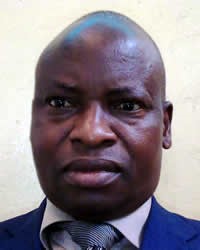

The Yansi are an ethnic group in southwest DRC. In the Bulungu territory they are called the Bamputu. Their territory is largely bounded by rivers—the lower Kwilu River between the mouth of the Kwenge and Kwango to the east and west, Kasai to the north, Inzia and Lukula to the south.
They are closely related to several other groups living nearby—the Nding, Mbuun, and Lwer. Their language is called Kiyansi and many also speak a trade language called Kituba. Traditional Yansi ames always end with consonants, in contrast with Kongo or Kituba names that end in vowels, but this is changing with the widespread use of Kituba.
They are ruled by three traditional kings, with about 120 chieftainships under these kings--sixty in Bandundu Territory, thirty in area around the city of Kikwit, and thirty in Masi-Manimba. The best known king is the Kinkie or Binkie king from the Kidzeme territory, who is called 'mfum ngol' (strong leader). The chiefs always come from oldest descendants of the founding family of the clan. They are assisted by the council of elders presided over by the chief himself. The council's decisions are binding. Of second importance is the secretary or assistant to the chief. He is an intermediary between the chief and the village people. The chieftainship is not based on age but on knowledge and wisdom. There are many villages within each chieftainship. Formerly the elders lived in one section of village and young families in another. In each village there are heads, then clan chiefs under them. In the past, adolescents lived in dormitories with others of their sex. Each clan owned fields and parts of the forest.
Belgian colonizers first met the Yansi at Bolobo town where they were trading on the Congo River. That town was burned down three times, but eventually friendly relations were established. The Belgian colonizers employed Yansi as bodyguards and later forced to work on palm oil plantations and used them as clerks or translators. Jesuit missionaries recorded some of their local traditions, showing they originated somewhere much farther north through mixed marriages with tribal chiefs in a region they called Kimput. Traditions mentioned a great river whose waters were salty and even large sailboats were unable to cross. Lived in semi-slavery in the land of a King called Mukoko. Later they became traders at edge of Pool Malebo (Stanley Pool).
Attilio Pecile, explorer wrote in 1887 that like other tribes around them they were mostly cannibals and noted their ability to navigate rivers. They were known as ivory traffickers who sold goods by canoes which were paddled by both sexes to the repetitive song of a team leader. The Yansi were exploited with forced labor by a subsidiary of Lever Brothers for the production of palm oil and living conditions in the camps were deplorable. However, the Yansi themselves employed many slaves. They recognized two classes of men: free and slaves. Their slaves were taken in war or as punishment for a crime, adultery, non-compliance, or debt. They could be sold, but they could also buy their freedom through money or work performance.
The Yansi are known for a strong desire for independence. They resisted dominance of Kongo Kingdom. In 1960 Bayanzi unsuccessfully demanded creation of a North Kwilu Province. ABAZI, the Alliance des Bayanzi was formed in late 1950's to represent their interests. After independence, there were clashes with other Bakongo groups and the central government.
The Yansi are matrilineal, meaning a child belongs to the clan of the mother, since they believe it is formed from the blood of the mother. The father responsible for finding wives for his children from outside the clan. Forced marriage were common in the past, and arranged marriage is still common, although seldom forced. The first daughter is obligated to marry her maternal uncle, with the grandfather entitled to receive the dowry. However, she can escape this rule by paying a double dowry.
Their economy is largely based on cassava farming and fishing. Mantete squash is cultivated primarily for the seed, which is eaten.
Almost all Yansis identify themselves as Christian, but traditional practices remain. Bayanzis acknowlege a distant creator God called Nkier a Mpung. They also believe in protective genies that guard their homes. They also believe in protective genies that guard their homes.
Grandparents are believed to be reincarnated in their grandchildren, dead or living. Ashes are considered a symbol of blessing and liberation from the grip of sorcerers.
'Mfumu' is the term commonly used for Lord in the Kituba trade language that is widely spoken amongst the Yansi, but the Iyansi Bible translators chose to use the term 'Mwol' in its place. It is the word for the clan of the chief and for the chief of a group of villages, whereas 'Mfum' is the chief of one village. Twins are called amwol and are venerated by the Yansi.
Road conditions, including condition of bridges has seriously declined throughout the country, making it difficult for farmers like the Yansi to get their goods to market. There is little employment aside from farming.
There is no electricity in the Yansi area except by privately owned diesel generator or solar panels. This greatly hinders communication.
Many churches have been splintered by repeated divisions, seldom based on doctrinal issues.
Pray for unity and cooperation amongst Yansi believers.
Pray that pastors will have a shepherd's heart and truly guard their flocks against false teaching.
Pray that Christian leaders will not be lured by position or power but will keep their eyes focused on Christ.
Pray that churches will flourish not only in population centers, but in every village.
Scripture Prayers for the Yansi in Congo, Democratic Republic of.
References
| Profile Source: Joshua Project |


